Saturday, July 17, 2010

July 17, 2010 - Caye Caulker

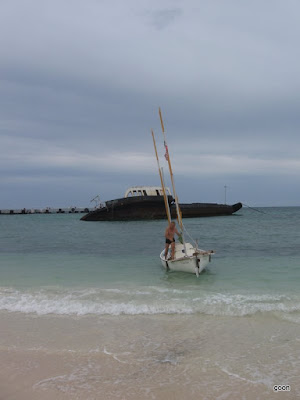
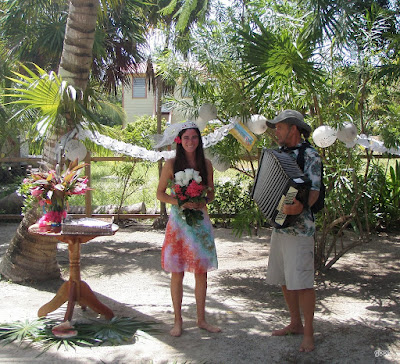
Well we really got married. Hopefully this doesn't mean we'll have to start acting grown up or responsible. We had a somewhat unique ceremony here on Caye Caulker in the yard of Hummingbird Hideaway, the property our parents rented for their stay on the island. The owner was really nice and helped us out with everything.


The ceremony was split into 5 acts, each representing a stage on the path to marriage. We asked our friends and family to participate, doing whatever they felt like to make the ceremony more interesting. Steve's cousin Kristy did Act 1: Exploration. She made a wonderful speech which made everyone teary eyed. Ginny's mom Lois did Act 2: Euphoria. She had us all blowing bubbles and popping fire crackers. Act 3 was Insanity. Ginny's friends, the Fantastics, contact juggled and eyeball juggled. Steve's nephew made everyone hackysack which was probably pretty funny to watch. Act 4 was Love. Steve's father sang some beautiful love songs, accompanied by Kristy for two of them. Act 5, Marriage, was the best one! Ginny's sister orated. Afterward we made our own little speech then bicycled off with clanging cans behind to another house where we had a feast of delicious breakfast foods.

It was definitely the best wedding which has ever occurred in all of time.


Twelve of our family and friends were able to attend. Way more than we ever expected! Everyone stayed about a week and we ran around a lot trying to get in as much time with everyone as possible. They left too soon! Now we've spent the last week or so on our honeymoon, also known as "boat work time"! Lots of little repairs and improvements needed, as per usual.


A couple days ago we were trying to sail to San Pedro in almost no wind to renew our visas when we saw someone waving from an anchored sailboat. A friend we had met in Mexico! He was motoring to Belize City and we decided to join him and do our paperwork there. How different it is to be on a 35 foot boat with a keel! It was a great trip, but we all got over confident near the city and stopped watching out for shallows. We ran aground and could not get off! A couple miles from the city we were able to dinghy in and get all our chores done, but when we took the water taxi back to Caye Caulker we felt terrible to see he was still stuck. Hopefully he's free by now.


We're back in Caye Caulker, with a couple more items on the "to do" list, then we plan on checking out the atolls. So much left to see in Belize!

More photos may be found in our Current Photo Album.

Tuesday, June 22, 2010

June 23, 2010 - Corozal, Belize

Hi Everyone,

Last time you heard from us we had just checked into customs in Isla Mujeres, Mexico. Isla Mujeres is a slender, three-mile-long touristy island with nice beaches. After Cuba the stores seemed to burst with fruits, juices, and cookies! Internet was everywhere. The main road running the length of the island buzzed with cheerful locals on scooters, wearing colorful plastic helmets, but it also carried countless golf carts loaded with sunburned North Americans in beach attire.

Isla Mujeres is also a yachting center. Twenty or so cruising sailboats remained in the harbor and in the connecting lagoon, but they were thinning out. Every morning the cruisers conferred by VHF, just like in Marathon. Each day more sailed north to Texas or Florida or south to Rio Dulce, Guatemala. Finally they canceled the net due to lack of participation. We tried tying to pilings where we could wade ashore but ended up anchored in the harbor for better breeze and privacy. Our neighbors at anchor became friends. We learned where to buy supplies and get things made out of metal. It was a good place for more boat work. We replaced the second of our flexible solar panels with a hefty 20 watt panel which provides more power than we know what to do with. We also made a new tiller tamer and spent an inordinate amount of time ordering replacement items on the internet for our parents to bring down to our wedding.


We had finally escaped winter. The 90-degree heat was bearable only due to the constant trade winds. We wore light-colored clothes and Keens sandals. Our tarp kept out sun as well as rain. We no longer needed a cover over us at night. Isla Mujeres is across the bay from Cancun, so it was an easy sail for us to return to our old hangouts in Puerto Juarez and see our friends Mark and Javier. We spent about three weeks in the Isla Mujeres/Cancun area, then began our descent South.

We started by sailing through the large mangrove lagoon that lies behind the hotel zone. We came out south of the hotels, behind the coral reef. The following days we sailed south, sometimes in front of the reef, sometimes behind it. There are gaps in the reef, but in a larger sense it is continuous. The beach was endlessly lovely. The forest behind was flat and bug-infested. Houses and tourist facilities dominated the coast but miles of undeveloped shoreline still remained.

In Puerto Morelos we spent a night at anchor in the lee of a wrecked ferry hoping for extra shelter from the waves, the reef being a highly imperfect breakwater. It didn´t help much. At another place we pitched our tent on the beach to avoid the bouncy anchorage, and stayed three days refinishing our oars. We passed the a mega-tourism center of Playa del Carmen without stopping and continued along a coast of rough, low rock with sandy bays. We slept in reef-protected coves and snorkeled amid surf-spumed coral and erosion-sculpted limestone. Mangroves often fringed the shore, their cloven roots dipping into the water like sharp, slimy fingers. In one cove Steve found the mouth of a subterranean river: cold, blurry water that filtered up through a bed of sharp rocks to lie in a layer over the heavier salt water.

Needing supplies, we entered Puerto Aventuras, a tourist resort the size of a city, with thousands of rooms and a large marina. The locals servicing the complex made up a large community in their own right; their homes and stores were on the other side of the coastal highway. We tied to a dock across from pens where tourists were paying to “swim” with dolfins and mannatees, but we never paid anything because the dockmaster´s office was closed. We got our supplies from the cheaper stores across the highway. In our wanderings Ginny found a baby great-tailed grackle (a sort of crow with a raucous whistle) in the street being batted about by a pair of cats. She brought it to the boat, made it a nest in the cabin, and fed it sugar-water from an eyedropper.

At Tulum we sailed up to the beautiful Mayan ruins, on a cliff overlooking the sea. The central tower was once a lighthouse marking an entrance through the reef; we entered where the Mayans once entered with their trading canoes. We had spent a lot of time in Tulum in 2008 when we toured the Yucatan by truck and canoe. Then we camped in our truck. This time we tried sleeping aboard. The water was too rough. So we pitched our tent on top of a wooded sand dune and waded through surf whenever we needed something from the boat. Our neighbors, also in a tent in the woods, were a lovely young Mexican couple. They were supporting themselves, barely, as street musicians. Steve got out his accordion and shared music with them. Tulum was the last sizeable town before we crossed into Belize, so we provisioned and used internet shops.
We went to a veterinarion, who advised Ginny to feed the baby grackle bananas and apples! Sadly, “Grax” did not survive her traumas. Ginny buried her in the upper beach and Steve drew a heart in the sand over her resting place.

After a week in Tulum we continued down a less-populated part of the coast. At a river mouth we took down our masts and rowed under a bridge to reach a series of lagoons that run parallel to the coast. We navigated these calmer waterways for a change in mood. We were told thehy were filled with crocodiles! Narrow, winding passages connected the several lagoons, the last of which widened to become Bahia de la Ascension, a vast bay with reefs and islands at its mouth. At the northern entrance to the bay, at the end of a long dirt road, was the town of Punta Allen. We stayed three days, to get a metal part fixed and to spent time with a couple travelers, a Swiss named Chris and an American guy named Goyo. Goyo we had met a couple weeks earlier, he was “Walking for Peace” along the coast, camping with his dog and spreading the word of a simpler, spiritually aware lifestyle.


After exploring the eastern reaches of Bahia de la Ascension a bit we sailed into open sea for the transit to the next big bay. This was our roughest day to date. We reefed way down and for the first time found it prudent to leave the drain plug out of Thurston’s stern. The waves broke in with such frequency and volume that we couldn’t bail fast enough, so we removed the plug and let the water around our feet find its equalibrium. We bashed away on a near reach and were glad to anchor in the next mammoth bay, Bahia del Espiritu Santo.
Our anchorage this night was typical of many along these shallow coasts, and was possible only due to Thurston’s mere six inches of draft. The reef broke up the big waves, but considerable fragmented wave energy got through. The lagoon behind the reef was four feet deep, The distance to the beach was sufficient for new waves to supplement the residual waves. But the lagoon shoaled evenly, the last hundred yards being under eighteen inches deep with a bottom of eel grass. The shallowness kept toppling the little waves until none were left where we anchored, in less than a foot of water. There is virtually no tide here so we never grounded out. Thus we enjoyed a still night though the trade wind blew directly onshore. We walked for miles along the unoccupied beach, opened coconuts for their water, and visited a couple of tiny fishing villages.
After Bahia del Espiritu Santo we followed a straight coastline, sometimes inside the reef, sometimes outside. Inside was calmer and we could stop whenever we wanted. The downside is that coral heads barely reaching the surface can appear anywhere inside the lagoon. We kept a constant lookout and often swerved at the last second. Once we had to get out and walk the boat through a labyrinth, careful not to touch the living coral.

We reached Mahahual, another town we had visited two years before. It stands by itself, a southerly outpost of the touristic Costa Maya. The last time we were here Mahahual was recovering from a hurricane. This time the cruise ship pier had been rebuilt and the “malecon” (seaside pedestrian thoroughfare) had been finished. While we walked the malecon the hucksters at the restaurants and artesan shops bonbarded us with invitations and attempts at shallow friendship; is it polite to simply ignore them? But the water was really clear! From Mahahual south the visibility was usually at least 40 feet. We saw turtles, nurse sharks, and barracuda most times we snorkelled, not to mention the countless colorful little reef fish which hang out, each over their own little niche in the coral rock. We renewed our acquaintance with familiar species and happily noted new ones. We rarely knew their names, but we remembered their faces.

The last time we were in Mahahual we heard about a massive offshore atoll called Chinchorro Bank, seven miles wide and twenty-three miles long. The problem is it lays eighteen miles to windward. To reach it, and similar atolls in Belize, could be the Mount Everest of our current voyage. They say these are the only atolls in the Western Hemisphere. What does such a place look like? And how crystalline and teeming with life must the water be? Finally we would find out! Knowing it may be prohibited to go there we didn’t inquire about permits or tell anyone our plans. The bank lay east, and our boat is mediocre to windward. Also, a branch of the Gulf Stream flows north at two knots through the deep straight between Mahahual and Banco Chinchorro.

We wanted to get there for Steve’s birthday on June 11th, so we got underway early on the 10th despite the east wind and started bashing into the waves. All day we were soaked and seemingly getting nowhere. After nine hours and only about 18 miles later the water finally changed from deep blue to shallow green. After two more hours we anchored in the lee of Cayo Centro, a mangrove island a half mile wide and two miles long in the center of the bank. How good the stillness felt!


In the morning we found ourselves in the midst of a vast marine wilderness. We swam along the mangrove shore past an unoccupied fishing village on stilts, and later sailed out to the the rough, eastern edge of the atoll. A strong current setting west across the reef complicated this swim, but we also explored several of the hundreds of the coral clusters scattered over the interior of the bank. Each was a little almost-island rising from a depth of perhaps twenty feet nearly to the surface. We sighted all the standard reef denizens, and some new ones.

We saw only a few fishing launches and Navy boats until the fourth day, when a Comision Nacional de Areas Naturales Protegidas (National Commission of Natural Protected Areas) official approached us to say we were in a biosphere reserve. We’d have to leave in the morning and refrain from further swimming! We complied with the first request but not the latter. The next morning; as we sailed back across the west dropoff, we couldn’t resist seeing what it was like. Quite different from the east side, where waves break, the western edge was calm and scenic, with a floor dropping from ten feet rapidly into great depths. Coral rocks with a high coverage of live coral studded the sandy flanks. Visibility was seventy feet!
We returned to the mainland and followed it to Xcalak, the tiny port of entry near the Belize border. Here, on June 16, we got our clearance and said goodbye to eight lovely weeks in Mexico.

To Ginny the five miles to Belize was excruciating. At one point a Mexican Navy boat came racing towards the side of the boat, but turned off.


We entered Boca Bacalar Chico and made our way wiggling west through the mangrove channels, we got lost down dead ends and sometimes had to paddle. Ginny kissed the first mangrove we crashed into on the Belizian side. So good to be back! We entered San Pedro harbor near sundown and anchored in some slimy weeds across from the fishing boats on shore. In the morning we made our way to immigration. We were early and the officer kept saying “oh man, you guys, it’s so early. Oh man. What, have you been waiting here since six? Oh man, it’s really early you guys.” Our first Belizian faux pas. The customs guy wouldn’t even come out to our boat, he said it was too early to get wet. They both said “Welcome to Belize”. That’s all we wanted to hear!

We enjoyed a couple days in the bustling city of San Pedro. The golf carts run wild in the streets, driven by tourists holding drinks and Belizians with noise makers celebrating soccer games. After learning our Oregonian friends who have a home in Corozal would be leaving for the states in a few days we decided to sail to Corozal to say hi before they left. We had a beautiful, relaxing, mind numbingly slow sail and met up with them a day and a half later. This is where we write you from today. Our time in Corozal has been peaceful, despite all the rushing around we’ve been doing trying to get our marriage papers done.


Oh yeah, did we mention we are getting married? We’ve set the date for July 1st and some of our favorite people are coming down to celebrate with us in Caye Caulker. It’s going to be excellent! Last minute attendees are welcome, especially if you are willing to play love songs on the spoons.

As you know we are very non-materialistic people who also happen to be quite short on space so if you want to give us a wedding present we request one of the following:
  • Adopt an Elephant in our name: http://www.sheldrickwildlifetrust.org/asp/fostering.asp
  • If you know one of the people who came down for our wedding donate some money towards their expenses.
  • Imagine we are normal people who want normal things, decide what you want to get us, then take whatever amount of money you would have put into that item and spend it on some activity or gift for yourself which will bring you real joy. A trip to the aquarium to see the seahorses or even just an ice cream cone. Then imagine we are the ones who gave you the item or experience. Your gift to us will be the opportunity to make you happy! So, if you choose this one be sure to tell us about it.
We have posted new pictures in our Mexico album and a few in our new Belize album. After the wedding we’ll update the blog with more pictures, though we won’t send out another mass email for a month or so. In other news, Steve's articles should have begun to appear in Small Craft Advisor so check them out if you get the chance.

Thursday, May 27, 2010

May 27, 2010


We´re in Tulum now! Our old home.
We spent a some weeks here on the beach a couple years ago and now we´re doing the same. The first night in the anchorage it was too rough and we had to find a place to pitch the tent. There is now only one place you can get away with free camping on the beach and we´ve found it. I guess it´s a skill we have. Spent the past few days swimming the reef, mourning the loss of our sweet bird Grax (Ginny rescued a baby grackler from cats, she didn´t survive the boat life long :( ) and provisioning for the last 150 miles or so before Belize. The rest of this trip through Mexico will be mostly through deserted beaches and mangrove lagoons. There is a lot of reef to explore and we are looking forward to going very slowly through it all.
There are 30 or so new pictures in our current photo album for your enjoyment. http://picasaweb.google.com/ginnygoon/ThurstonInMexico#

Sunday, May 9, 2010

May 9, 2010

We have been back in Isla Mujeres for a few days now after spending a week in the Puerto Juarez/Cancun area. For the first time we reached a place we had been before and had the luxury of seeing old friends.


We anchored just off "Playa del niƱo" and waded to shore. This is the first beach we ever saw on our trip into Cancun two years ago (turns out there aren't many public beaches despite how many there are for tourists) and the same beach upon which we met Mark and Javier. While in Puerto Juarez we made sure to spend a lot of time hanging out with them and their awesome pets.


Besides hanging out, gorging on delicious Mexican food, and marveling at the plethora of products and services available in this rather affluent part of Mexico, we have also been accomplishing some things.

Steve has been writing articles for "Small Craft Advisory", a small boater's magazine which you may be able to find in your local book store or West Marine. So far he has written three, and will continue to write them as we expand our travels. Presumably there will be one per month starting in a month or two. Also, we settled on a time and place for our hobo wedding. July 1st in Caye Caulker, Belize. Some of our favorite people in the world will be coming and we are getting very excited to see them! Lastly, We bought a fancy new solar panel and since being back in Isla Mujeres have installed a whole new electrical system. Thanks to our awesome neighbors here in the harbor we didn't even screw it up! Now we have more juice for working on our photos, writing to-do lists and watching cartoons. All the most important activities.

Soon we plan to return to Cancun to hang out a little more before going off on our lonely way South. There are 23 new pictures up in the album "Thurston in Mexico". Enjoy!

Sunday, April 25, 2010

April 25, 2010 - Isla Mujeres


April 25, 2010

Dear friends and family,

You last heard from us in Marathon, Florida on March 10. We had gotten our boat into good enough shape so we no longer felt it necessary to return to Larry Whited`s house to work out bugs. To continue southward meant going to Cuba.


The U.S. has a trade and travel embargo against that island nation and we were afraid of getting in trouble for violating it. But we read that if you go there for professional reasons, such as journalism, you are eligible to go under General License. I have already published one book about my travels and we are writing up this journey too. So we figure we`d be legal but we wanted to keep a low profile anyway so we didn´t announce our intentions. And since the authorities keep a close watch over the waters between Florida and Cuba we decided to go to the Bahamas first, then Cuba.


As in my 1993 crossing the best-situated stopover is tiny Sal Cay, which is on the edge of a vast shallow bank, quite separate from the rest of the Bahamas. We sailed out of Marathon and out into the Straits of Florida at 6:00 PM. It was soon totally dark, no moon or stars. The motion was disconcerting flying blind like that. We seemed to be going much faster and more precariously than if we could see. Also we had the Gulf Stream to worry about.


Our goal lay to the SE but the current flows NE. From our actual track per our GPS, the current seems to have been flowing about as fast as we were sailing. We steered south to counteract the current, which was a mistake. It cut our speed way down. We should have cut straight across. Time went by incredibly slowly. We yearned for dawn!
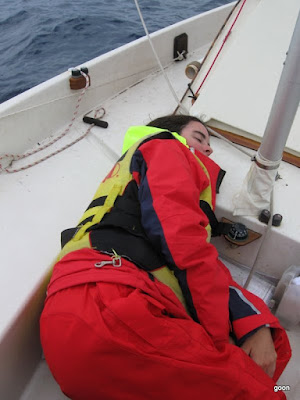


When finally we could see, the ocean around us was empty, with conflicting patterns of slow swells. There was no wind so Steve rowed. The wind returned, faster and faster. Around noon we escaped the current´s clutches and entered Sal Cay Bank, flying through a broken perimeter of sharp, tall rocks against which the sea bashed. Dead Man Rocks! Inside the water was about 30 feet deep. Sal Cay lay 25 miles across this torquoise bank. We sailed all afternoon and arrived before dark. Night landfalls are dangerous! Sal Cay is still a remote, lovely island. We didn`t go ashore because we weren´t cleared to enter the Bahamas, but it was nice to sleep at anchor in calm of the island`s lee, at least it was nice until 3:00am when the wind changed.


We still had half the distance to go. Cuba lay another 40 miles south, then we had to travel 35 miles west along the coast before we could enter at a legal location, the resort town of Varadero. We left at noon. As it got dark we saw a Cuban lighthouse beacon probing out over the sea. We turned west, keeping miles away from land, afraid to violate their territorial waters prematurely.


Another endless night. At 10 PM the wind suddenly increased alarmingly. We reefed both main- and mizzen-sail until each was a small triangle. As Thurston rolled and pitched we braced ourselves and again wished we had stars to steer by. Then land lights started appearing. Varadero became visible: ten miles of beach lined with tourist hotels. At dawn we turned landward and entered a narrow channel with surf crashing on either side. We tied up at a small marina. Safe!


For two hours we underwent formalities with a variety of officials, then we were free to wander. The marina is temporary home to ten or so yachts, mostly Canadian. We immediately connected with our fellow sailors and starting learning the ropes in Cuba. Everything is strange! There are two currency systems, one for buying some things, the other for buying other things. Some things are ridiculously cheap, like ice cream cones on the street, if you can find them. Other things are expensive, like international phone calls for $2.50 per minute. Most things, however, you just can`t find, like writing paper or building materials. Or maybe you can with vast effort and connections, because a lot happens on the black market. This is a communist country. With certain exceptions it`s illegal to run a business, own a car, or have a foreigner stay at your house. Cubans aren´t allowed to visit the boats in the marina. One of the Canadians has been married to a Cuban woman for seven years but still he can´t stay at her apartment because she doesn´t have a license to lodge foreigners!


Still, the Cubans are wonderful people. We enjoyed exploring the hotel zone and the adjoining town of Santa Marta. It´s like a land that time forgot, with its pre-revolutionary cars, mostly 1950s Dodges, Chevys, Fords, and Chryslers. Also decrepit little cars and motorbikes from behind the Iron Curtain. They keep them running because they can`t buy new ones. Many people get around by horse and buggy. They play baseball a lot and ride around on bicycles.


After eight days at Varadero we felt acclimatized enough to continue our journey. The coast leading to Havana has few harbors. We requested permission to anchor in Santa Cruz del Norte one night, to break the trip in two and avoid sailing in the dark. They said we couldn´t stop except at marinas, and there are only five marinas on the entire north coast. Finally they said we could anchor there provided we didn´t land. When we entered at Santa Cruz, through a narrow break in the tall, rocky shore, soldiers at a Guardfrontera post at the entrance yelled at us to go away. They were very disturbed by our presence. Steve yelled back that we had permission. Eventually they allowed us to anchor in front of the military station.


At the first hint of light maybe twenty tiny wooden fishing boats with putt-putt motors started circling around us. Evidently they were chomping at the bit to go out and fish but are required to wait in front of the Guardafrontera station until light. When streaks of red cloud appeared in the eastern sky they all left and dispersed into the ocean with their hand-fishing lines out. The government is afraid Cubans will escape to America by boat. Tens of thousands already have!


We next stopped at a marina called Tarara, ten miles before Havana. The opening to the marina was only a foot deep, plenty for us but impossible for most boats. So we were the only customers. The plumbing and lighting fixtures tended not to work, but the people were friendly. Four or five guards watched over us every night. The surrounding community was mysterious! We were in the midst of a vast residential complex which was well constructed and well tended, unusual for Cuba. But the houses were empty and the entire area was surrounded by a fence. There were also many large dormitories filled with Chinese students learning Spanish. Ukrainian victims of the Chernobyl nuclear accident also live in Tarara. In fact, the 20th anniversary of the disaster occured while we were there. They held commemorative events, presided over by a former Ukrainian president. And that was it: Chinese students, disabled Chernobyl victims, guards, groundskeepers, and us. The entire place was surrounded by a fence, no regular Cubans allowed.


Twice we went into Havana by an incredibly crowded bus. We walked for miles around this fascinating city, so full of ornate, dilapidated Spanish architecture. Vendors and shoppers thronged the dirt-floored farmers markets. Pedestrians hung out along the wide waterfront sidewalk, where the ocean waves crash and soak you if you aren´t quick.


We then sailed to Hemingway Marina, on the other side of Havana. This is Cuba´s largest marina. We were one of perhaps a dozen inhabited boats, including French Canadians, Swedes, and a delightful Argentine who had recently bought a big Morgan sailboat in Florida. Boats frequently arrived from or left for Mexico or Florida. We went out each day in search for places selling things for the ¨moneda nacional¨ pesos because these items were always extremely cheap. Now and then you could find pizzas, sugar cane juice, or muffins. But usually they were out of food. Bread, fruit, veggies and street food are all sold in MN. We ended up getting stuck with about five hundred of these pesos, worth a nickel US each. Oddly enough, the other Cuban currency, the CUC, is worth about 20% more than the US Dollar and is used for the rest of the few products and services one can find. A fresh loaf of bread costs 15 cents, but processed, packaged bread costs about $3.00 (If you can find it, which is highly unlikely.)


Next we sailed to a harbor used as a graveyard for dead ships, where we were again watched over by Guardafrontera and forbidden to go ashore. Then we stayed at Cayo Levisa, a small island with a tourist hotel. We tied to a piling in the water and did a lot of swimming and beach walking. This was one of the few places we were able to go ashore so we stayed a week. We have finally arrived where the water is warm enough to swim!


From Cayo Levisa the coast consists of a reef of coral origin which partly protects a lagoon or gulf one to 25 miles wide. There are many mangrove islands within this inner sound, some with a patch or two of sandy beach. The mainland, forbidden to us, is mountainous and relatively unpopulated. In these waters we traveled and anchored without supervision.


On the fifth day we reached Los Morros, just inside the curling tip of Cabo San Antonio, the great western cape. The only sign of man was a dock, a restaurant, a marina office, and a narrow road leading into the flat tropical forest. Yachtsmen come here for refuge before and after crossing the Yucatan Channel, but we were the only yacht there upon our arrival. We tied up and walked down the road and along the beach, all the way to the lighthouse at the cape itself. Around that tip is the Caribbean!


When we got back an American yacht had arrived with plans to leave for Isla Mujeres in the morning. Isla Mujeres is a small island off Cancun, Mexico, on the Yucatan Peninsula. The owner, Jim , invited Steve aboard early the next morning to listen to a weather forecast on his single sideband radio.


We had been considering continuing around to the south coast because they say the water is clear and deep there, ideal for snorkeling. But the forecast called for moderate east winds, bad for the south coast but good for crossing to Mexico. Jim was interested in ¨buddy-boating¨with us. Steve convinced Ginny we should jump at this weather window. The tanks were already full of Cuban well water, purified by pumping it through our REI filter. We already had a planned route for the crossing. We proposed to sail 120 miles southwest before cutting across the current itself. This would be extra distance but it would prevent the Gulf Stream from sweeping us north into the Gulf of Mexico. It looked good to Jim. A couple hours later we were underway.


While we headed straight to the cape Jim circled way around it to avoid coral heads. We figured Jim would catch up with us by motor-sailing, but after some confused VHF contacts we concluded he wanted to take a different route. He was soon out of sight.


It was sunny, hot, windy out of the ESE. For 25 miles we sailed due south, on a near reach. Then we turned SW, more off the wind, faster. Night came, but this time there was a half moon overhead and stars were visible. We would steer to the proper course by our compass, then note a star, and steer by it. We could see the surface of the waves, which allowed us to steer through the waves better. We were better able to brace for the rolls and yaws. All night long we sailed fast. Steve took a couple catnaps curled up at the forward edge of the cockpit. At first Ginny was anxious and lacking in self confidence, having drank way too much coffee and without any time to mentally prepare for the journey. She was unable to sleep or eat. But before long she reached her zen, was able to relax, and performed well.


Morning found us at the end of our SW-bound leg. We were on course. Currents had not affected us because we had stayed in extremely deep waters, typically over 13,000 feet. But now it was time to turn west, where we expected current. That would be good in that it would help carry us to our destination, which was now to the NW. But it would be bad if the current interacted with high wind to make big waves.


The wind increased to 20-25 knots. The waves grew to eight feet. We reefed until each sail had less than half its area up, and still we maintained six knots! Now that we were going down the waves at a diagonal we had to steer carefully to prevent broaching, a type of capsize in which the boat turns upwind and rolls onto its side. Water had been splashing into the boat all night, but now bigger waves occasionally sloshed in. We kept bailing. Sometimes we had to throw out little fish left wiggling on the deck. Once a little land bird considered landing on our boat because he was too far from shore, but he lacked the courage to stay with us.


Would we arrive before dark? The map showed a place called Arrowsmith Banks, where the water is under 100 feet deep. A cruising guide said the current is strongest there. We stayed south of it. We never saw much current until mid-afternoon when we were heading NW, thirty miles from Cancun. A knot or two of current finally kicked in, boosting our speed. The mammoth Cancun hotels started appearing on the horizon! Several hours later, as the sun went down, we rounded the point and anchored in Cancun harbor, just offshore from a series of lovely, lofty resorts. They extended high into the sky above us, blocking the blasting wind. Clients played in the water on the sandy beach 100 yards away. The sound of dinners and cocktails wafted over the water. We took off our salt-encrusted foul-weather gear. Steve´s butt had sores where his ilia bones stick out. Ginny was physically and emotionally spent, having been nowhere near as good at napping as Steve.


We lay down in the cabin and slept, relishing the lack of motion. Mexico, finally! We´ve been two years getting back here. First finding a boat that could carry us, then modifying it, then sailing it here. And after this is just gets better: the reefs, Belize, Guatemala, etc. And none of that requires long passages!


In the morning we sailed across Cancun harbor to Isla Mujeres, the yachting center. Here we cleared customs and found some pilings to tie to where we can wade ashore. The stores are lushly stocked with fruits, juices, and cookies! Internet is affordable. Every morning the cruisers confer by VHF, just like in Marathon.


We are looking into whether any of the boats going to Florida want to take us as crew. If so we would drive our truck back around to here. It would be nice to have it available to us, but not mandatory. We´ll get married soon, but we haven´t decided where yet. Would anyone want to vacation in Los Angeles or Cancun or Belize in the near future if it included attending our wedding?


Click here for our latest photos. We hope you are all doing well and that there is some adventure in your life too.

Wednesday, April 14, 2010

April 14, 2009

Just a quick note to let you know we're alive and having a wonderful time. We have many stories, but cannot do a real update for another month. For now be content to know we are sailing, sunburning and snorkling to our heart's content.

Wednesday, March 10, 2010

March 10, 2010 - Boot Key Harbor

Hi guys,
Here is our latest mass email which summarizes in a little more detail our journey since Everglades City.
There are about 20 new photos in the Current Photo Album.
________________________________

Dear friends and family,

Unless you’ve been following the blog (http://ginnyandsteve.blogspot.com), you last heard from us in Everglades City, Florida on January 12. We had just survived the big freeze that killed so many fish and reptiles. In Everglades City we bought all the groceries we could carry then sailed south through Everglades National Park.

We were in or near the open Gulf of Mexico most of the time, but we also traveled some of the tidal passages between islands. Each day we reached a new key and tied up there. Sometimes there was solid land to walk on, sometimes not. Sometimes we saw other people, sometimes not. One day the weather and water were warm so Steve relieved some curiosity by intentionally tipping Thurston over in a calm creek. Once past about 60 degrees she capsized to the point where the masts hit the bottom. He swam underneath and pulled the masts out. She rolled over a little more but the buoyancy of the cabin caused her to float extremely high and cocked to one side. Steve stood on her upturned belly, tied a rope to the high side, and leaned back toward the low side. She righted! It’s good to know we can rescue ourselves from a capsize.

As we approached Cape Sable, where the land bends to an east-west direction, the winds became contrary, so it took us four days to round this major headland. Then we sailed east through Florida Bay, which is extremely shallow and dotted with small islands. We ran aground several times but within 24 hours we were in the Upper Florida Keys.


We landed at the town of Islamorada on Plantation Key. We anchored in front of a city park for three days. The authorities said we were illegal there so we moved to Upper Matecombe Key, which is where Steve landed at the end of his famous 1990-1993 voyage. We anchored in a bay on the Gulf side where we could wade to a public street end. We took the bus to various stores as necessary to further improve the boat. For example, we upgraded our cushions, reinforced a leaky mast step, and installed a stern light. The local police didn’t like us there either, though, so we moved to a canal hidden in an abandoned forest on the Ocean side of Windlay Key. No one noticed us while we reconfigured the footrests that Steve uses when he rows. (The new footrests are integral with an open stowage bin on the forward side of the lazarette.) Whenever we emerged from the woods onto the public road we were careful to not be seen, so the cops wouldn’t run us off again. It’s unclear whether we’re actually breaking any law; according to one interpretation even a small boat is required to have a sewage holding tank if lived in full-time. It is abundantly clear, though, that the Islamorada police don’t like hobos!

After three weeks in Islamorada we sailed, over the course of three days, to Marathon, the next town down the chain of islands. In the center of Marathon lies Boot Key Harbor, where hundreds of boats lie at mooring buoys, at docks, and at anchor. Many of these boats are lived in fulltime. The liveaboards are a complete community, with a daily 9:00 am radio discussion on VHF. We couldn’t find anywhere to anchor where we could wade ashore, so we anchored among mangrove at the inner end of the harbor. Then someone gave us a free inflatable dinghy! Once we had replaced the missing oars and oarlocks we were able to easily get ashore. Now it’s hard to see how we got by without a dinghy! Some boaters stay here for a day or two, others have been here for years. We’ve made friends from New Brunswick, Ohio, and Ontario, all of whom spend some portion of their time living aboard sailboats.


Marathon is even better situated than Islamorada for getting boat work done. A West Marine, a Home Depot, a library, and food stores are all within walking distance. Here we have added shelves, spice racks, and a rain tarp. We’ve also added secure closures to our water tank caps because they were coming loose and spilling our drinking water. In fact, we have so successfully worked out Thurston’s bugs that we no longer deem it necessary to return to Larry’s house in Georgia before proceeding toward the Caribbean, which remains our destination.


You could say that our shakedown cruise is now done and we are poised nearly as far south as you can go in the U.S. The weather is finally warm enough to wear T-shirts, but the water is far too cold to swim. Must . . . go . . .further . . . south! But Cuba blocks a direct southerly route. Should we go east around it or west? Stay tuned!


We hope you are all doing well and that newness spices up your lives with sufficient frequency.

Friday, January 29, 2010

January 29, 2010

Hi Guys,
We made it to the Keys after an eventful 10 days or so of sailing through the Everglades. To those of you with a map, We went from Pavillion Key to Graveyard Creek, to the Little Snake River in Ponce de Leon and holed up a few days in Little Sable Creek. It was there we discovered a gallon and a half of salt water in our bilge (yikes!) and had to take the boat entirely apart to find the source. The main problem we found was a leaky mast step, we have since sealed that up to the best of our ability. Having the boat apart was a great opportunity to do some capsize tests.


We found she floats very high in the bow due to the cabin. Steve had an easy time flipping her when we had the masts out, but it was a little harder with the masts. Though they float now when apart, they can't keep from being pushed all the way down with the weight of the boat behind them. Important things to learn!


Next we spent a couple days in Lake Ingraham (there are tons of tiny channels we crashed ourselves into so as to get out of the strong winds). When we got sick of hiding from the wind we went out only to be greeted by a front as we reached the point of no return. The horizon to the North darkened until it was black and the sea was a sickly yellow green from the last bits of sun still coming from the South. We saw bolts of lightening in the distance and Ginny got pretty nervous. When the front hit the wind started coming from behind us, propelling us through the waves which had not yet caught up with the change in wind. The sky was dark all around and the thick raindrops plopped into the waves fast and constant. We became unable to see land and Ginny bailed like crazy just so as to have something to do to avoid becoming too freaked out.


It didn't last too long though and the resulting change in wind allowed us to speed to Flamingo where we we rewarded with an excellent anchorage right on the Coastal Prairie trail that leads between Flamingo and Clubhouse beach.


After a couple days there we sailed across Florida Bay with the intent of landing near to where Steve landed on his arrival back in the US after his three year voyage. To do this we had to defy the advice of wiser people and cut right through the middle of the bay, navigating tons of shoals and hard to find channels with the aid of a 25 year old chart. No regrets. It was beautiful! The water became clear and Steve even saw a sea turtle.


So here we are in Key Largo today with our boat anchored by a park in Islamorada. We are reprovisioning and planning on spending a week re-fixing all the things we already fixed that came apart due to faulty epoxy! Always with the boat work. Maybe we'll even find some time to swim!

There are about 35 more pictures in our "Current Photo Album"

Tuesday, January 12, 2010

January 12, 2010

It has been about a month since you last heard from us, and an eventful month at that! We left Atlanta on December 10 and drove to Niceville, Florida to visit Ginny's friend Stephen. He hates Florida, but at least he has a nice girlfriend there, in our opinion. His ultimate goal is to make it back to Hawaii and we wish him luck, and not just because we want to visit him there! During a cold storm we went for a long night walk on the Gulf beach. The sand was blinding white and crunchy the way cold snow is crunchy, so Steve kept subconciously thinking we were walking in snow!


We stopped in Panama City to show Thurston to her previous owner, and in Largo to see our friend Ron Hodinott. Then we sped southeast to Miami to meet with Bremerton friends Danny Stroberger and Betty Boop, who were on their way back from Haiti. We spent an amazing evening together at a Haitian "jazz club" jamming with their musical friends. Danny and Steve took a swim in the Atlantic before Danny and Betty had to catch their flight home.

Driving west back through the Everglades we saw many lazy gators enjoying the warm sun. But rainstorms began upon reaching the Gulf coast, keeping us holed up in the truck a couple days.


Now the good stuff. On December 19th we left our dear truck and trailer on the property of an acquaintance on Pine Island, near Fort Meyers. We launched our newly finished boat in shallow Pine Island Sound, sped on a beam reach across to Captiva Island, and spent our first night in a mangrove lagoon. Only fifty feet of mud separated us from a road in the middle of a swanky resort! With muck-covered legs and our hair full of sticks we must have looked a sight emerging from that primordial thicket! But no one seemed to notice us.


From that night on there has been no question whether the boating life suits us. It definitely does! We typically row or sail about fifteen miles (the days are so short this time of year) then anchor parallel to a sheltered beach. We place one anchor forward, one astern, and tie a line to something on the beach. To step ashore we just pull on this third line. Around Christmas time we spent four days at ritzy, condo-infested Marco Island due to high winds and the need for some minor boat refitting. Then we proceeded into the Ten Thousand Islands, which are the saltwater southwest edge of the Everglades.


For nearly two weeks we camped on uninhabited Panther Key. It has some beach around its edges but is mostly mangrove in the middle. We arrived several days early for a gathering of small sailboat enthusiasts organized by Ron Hodinott. We anchored in a tiny lagoon that drains out at low tide, leaving us aground. It was a good place to make further boat improvements, such as a rope-steering system so Ginny can steer while Steve rows. We set up the tent on the beach and had a campfire going when Ron and his friends got there. Unfortunately, their arrival coincided with a record low temperature and high winds. The water in the cockpit froze one night! The other boaters left; we stayed on, merely surviving. We scavenged old clothes and pillows from an abandoned campsite and wore everything we had. For two days we barely left the tent. We weren't prepared for "Arctic in the Everglades!" Thank you Jenna for the cashmere sweaters you gave Ginny!


Yesterday it warmed up a little so we sailed here to Everglades City, our last place for provisions before the Keys. We will skirt the Everglades National Park then probably sail to Marathon Key. This may take a week or so. We don't expect to see many people.

We hope you are all enjoying your central heating! We'll try to update the blog again in a week or two. There are about 50 new photos in our "current photo album" which is linked on the left.

Wednesday, December 9, 2009

December 9, 2009

Friends and family,

You last heard from us on October 6 when we had just returned to our friend Larry’s house near Atlanta. The household now includes Larry (nurse, works nights), Karen (HR clerk for the local fire department, works days), and Karen’s 18-year-old daughter, Alison (budding actress, works and studies odds hours). Consequently, there is almost always someone awake and someone asleep at any given time! It's a wonderful place to be and we are very grateful to our Stone Mountain family for always making us feel so welcome.

Steve gets up at dawn and starts the boat work. At 9:00 he hands Ginny a cup of coffee and says, “Hey Babes, here’s your coffee.” She mumbles a thanks and comes slowly to life (sometimes). Except for leisurely meal breaks we have worked full days every day getting our boat ready to cruise. Along the way Ginny’s cat, Thurston, unexpectedly passed away back in Seattle with Jenna, Ben, Carley and a giant bag of catnip at her side. Now our boat is named Thurston (just as Steve’s Squeak was named for a dear, departed cat.) in her memory and in hopes that her spirit will bring us good fortune in our travels.

This last boatyard stint has been three months (already?!). In Atlanta last spring we worked four months. Before that we worked in the junkyard in Tampa for three months. Ten months total, but she’s ready!

In this last session of boat work we have finished the aft stowage locker (“lazarette”) and rowing station, applied anti-fouling bottom paint, made cabin cushions, installed a solar panel and simple electrical system, and many smaller projects. We’ve packed utilizing every cubic inch (Ginny’s specialty). We have loaded up on charts, digital maps, ebooks and simpsons episodes aplenty. Now we even have a place to leave the truck and trailer, on a guy’s property near Fort Meyers. That’s about 2/3 of the way down the Florida peninsula on the Gulf of Mexico side.

Tomorrow we leave for Florida. We will stop by Fort Walton Beach to visit good 'ole Stephen, then drop off the boat at Pine Island and zip down to Key West to see Dan and Betty before they head back to Washington. After that we plan to cruise southern Florida, plus maybe Cuba, the Bahamas, the Yucatan, and/or Belize, until spring. Then we will probably return to Larry’s, refine Thurston based on live-aboard experience, return to Washington in the summer, then start our REAL voyage in the fall. At least that’s our best guess for now. We’re pretty sure Thurston will kick ass, and we look forward to finally doing a lot of swimming, rowing, sailing, wildlife-watching, etc.

Ginny’s got some funny pictures (a few below), so take a look! Our love to you all!

Steve and Ginny

Photo Album: http://picasaweb.google.com/ginnygoon/TheAdventuresOfGinnyAndSteve#


Sunday, November 29, 2009

November 29, 2009

Still working. We are getting very close to being ready to leave. Recently we've decided we need an electrical system after all. So, we installed a 12-watt solar panel and a cute little 10.5amp alarm battery. This should be sufficient to charge our phone and netbook so we can read lots of ebooks and compile more pictures for the photo-greedy among you. Speaking of which, we've uploaded 14 more to our album, a few of which are below:


In response to the $580 quote we got on a boat mattress we decided to make our own. It turned out Awesome!! We even had enough left over to make a little bed for Ginny's cat Snazz.


We also decided we needed an "anchor buddy", so we tore up some old batteries to get free lead (and yes, we were quite aware of all the many levels in which this was a terrible idea) and then broke down and bought some lead after two batteries only yielded 10 lbs worth.


We painted Thurston's name on the boat :(


... and had a tiny bit of extra time to hang out... But only while working!

Tuesday, November 17, 2009

November 17, 2009


Have you noticed lately the dramatic increase in the misery of existence? The black hole of despair eating the entire universe? Well, don't fret too much, everything will end soon enough. It is true that the world revolves (revolved) around only one creature and sure enough it must be stopping now with her passing. Presumably we will all disappear within the next few days. Thankfully.

So, go crazy! Punch your enemies, hug your cats, loot your neighborhood grocery store, and try to find some meager pleasure in our new and entirely unwelcome Thurstonless Universe.

In memory of our dearly departed fuzzy friend we have finally christened our boat, Thurston, a name that will carry with it the wisdom, dignity and pure spirit of the world's most perfect creature. Also, hopefully, it will act as a beacon to her ghost!

It's hard to remember what we were doing before, but there are some new pictures in our photo album.