Saturday, July 28, 2012

Caceres, Brazil


 Dear friends and family,

We last wrote as we were leaving Manaus after a stay of over two months. On June 14 we motored to where the Rio Negro joins the Amazon, the black and tan waters mixing only slowly. The combined river averaged four kilometers wide.

On the banks were half-immersed houses, the Amazon being in flood. At dusk green parrots cawed as they flew overhead, and monkeys scampered in the trees, their presence noticeable by waving branches. We motored into a matrix of inundated forest and open waters, not knowing if the latter were normally clearings or lakes, and tied to a tree. A current flowed through, streaming us away from the tree. We were within view of ocean-going freighters on their way to Manaus.
When Ginny slid open a floorboard to start dinner she found three inches of water in the bilge! We found a small hole through the hull just below the waterline aft on the starboard side. On our last disembarkation in Manaus, to get fruit and vegetables at the municipal market, the boat had bumped against something projecting from the seawall. It must have been sharp! Fortunately the inflow was slow.

The next morning we found a solid bank to work on. Positioning Thurston under a tree we ran a line from the starboard quarter to an overhead branch. By hoisting upward we raised the hole above the water line. Steve patched the outside with fiberglass cloth and epoxy resin. To the average person the hole was inaccessible from the inside, but Ginny managed to squirm in and patch it there too.

Rather than proceeding to the mouth of the Amazon we had decided to first explore southern South America. Consequently on the third day we turned right up the Rio Madeira. We hoped to ascend it and its tributaries along the Brazil/Bolivia border to the head of navigation in Vila Bela. From there a short transport could put us in the Paraguay/Parana river system, which we would descend to Argentina. We had only 80 days left on our Brazilian visas. If we failed to reach Paraguay in time we could enter Bolivia, but then we would be stuck for six months because there are no river routes through Bolivia and Brazil requires tourists to leave the country for six months before they can re-enter.

We motored from sunrise to sunset every day. At first the Madeira, like the Negro and Amazon, was so vast that land could not be seen on portions of the horizon. As we proceeded upstream it narrowed. The flooding decreased until muddy banks were exposed. The shore was primitive forest interspersed with altered scrub. The trees become shorter indicating less rainfall, but remained exquisite in their varied shapes and smells. Each homestead was a gap in the forest with a planked house on stilts, a few banana trees, farm animals, dogs, kids, and a canoe out front.

The same craft plied the river as we had seen on the Rio Negro: canoes, river boats, and tugs pushing tows of up to six barges. The upper Madeira also had hundreds of garimpeiro barges: small wooden flatboats that anchored in the river and sucked up bottom sediment with a thick hose to extract gold dust. They often tied up side-by-side for companionship while they worked.

We minimized contrary current by hugging the insides of the banks, swerving in and out to avoid projecting snags and branches. Leaves and twigs littered our decks whenever we brushed against vegetation. Grasses and lilies often crowded out from shore, requiring detours. Dead canes swirled in the current. We took turns steering. The other person would sew, fill water bottles, write, or do laundry. Thurston often had clothes drying along the horizontal masts. When darkness fell the mosquitoes came out, so upon stopping we hurriedly snapped the mosquito net around on the cabin hatch. We made one for the cockpit too, so Steve could sit there while Ginny cooked dinner.

Every few days we passed a town. Borba was named for a long-ago monk, a thirty-foot tall statue of whom stands before a blue-and-white church. At Nova Aripauna the main street was thronged with uniformed school children celebrating a scholastic milestone. Each had paved streets busy with motorcycles and pedestrians but no roads connecting the towns. The heart of each was the municipal floating dock, where passengers waited for boats to depart and goods were hurried to their destinations. Stevedores carried refrigerators, bicycles, etc. ashore via a wobbly gangplank while plantains and similar exports moved in the opposite direction.

We always wondered how long the Honda 2 horsepower motor could be ran at ¾ throttle. On June 24 we found out. It had started using oil. Its oil capacity being only a quarter liter we failed to check the level often enough. Sounds of destruction issued from the engine. It stopped, compression-less. Probably a broken valve, unavailable in Brazil.

Should we give up and go to the mouth of the Amazon? We would still have time to row and sail there if we hurried. Or buy another motor and continue up the Madeira?

Deciding in favor of the latter we rowed back down to a line of garimpeiro barges and tied up to them. Twelve of them lay at anchor in the full stream of the river, secured side-to-side to each other. Each had two horizontal wooden cranks for controlling lines. With one the operator lowered or raised the suction head. The effluent gushed out of a large hose onto a carpeted ramp. The carpet caught the flecks of gold. Every half hour or so, when the excavation became too deep, they would all start whistling to each other, a sign to crank the second roller and pull themselves closer to their anchors. They would then re-lower the suction heads and start a new hole. Each morning they turned off their engines long enough to remove the carpet and agitate it in a tank of water with a mercury additive. They then collected the gold dust that had settled at the bottom of the tank.

The garimpeiros were young men. They worked in two-man teams, many with their brothers or cousins. They operated twenty-four hours a day, six days a week, on six-hour shifts. The off-duty man slept in a bunk in the attic of a thatched roof. Twelve diesel engines powering twelve suction heads made for a formidable round-the-clock rumble.

One of the garimpeiros offered to sell us a used motor rabeta. which means “little-tail motor.” No one in the Amazon uses outboards under 15 horsepower. Instead they use 5.5 horsepower stationary motors with horizontal crankcases to which a long propeller shaft is bolted. The unit is mounted to the stern with the propeller shaft angling down and aft. They steer via a tiller pointing forward. The motor rabeta in question failed the test drive, conking out repeatedly, so we waited for a tow to the next city, Humaita.

After two days with the garimpeiros one of them took Steve in his skiff to speak with a passing boat. They were Catholic missionaries providing scheduled services in tiny communities along the river. A woman Ginny’s age said that they would gladly tow us to Humaita, where their diocese was based, but that it would take them four days to get there. We accepted, bade goodbye to our garimpeiro friends, and tied Thurston to the stern of the Edigio Vigano, a stately one-story wooden river boat.

The woman was Ianda, a nun from southern Brazil. She wore blue jeans, never a habit. The priest was a tall, jovial Cameroonian named Cristian who had moved to Brazil six years before. The boat also had a skipper and a cook, so there were six of us. The Edigio Vigano was well-organized, with mosquito screens for all the windows. The skipper showed us below decks, where a low-ceilinged engine compartment ran the length of the vessel. On deck she had one main room plus sleeping cabins, pantry, galley, and head. Once we were sure Thurston was being safely towed we spent our days aboard the Edigio Vigano and shared meals with them.

In the following four days we stopped at nine communities. Each had five or ten wooden houses. The staple food was manioc, the crumbly kernels of which they roasted in a huge pan over a fire, stirring with paddles. They also grew cacao, from whose large pods come the dark seeds that become chocolate. In the evening they cast-netted little catfish.
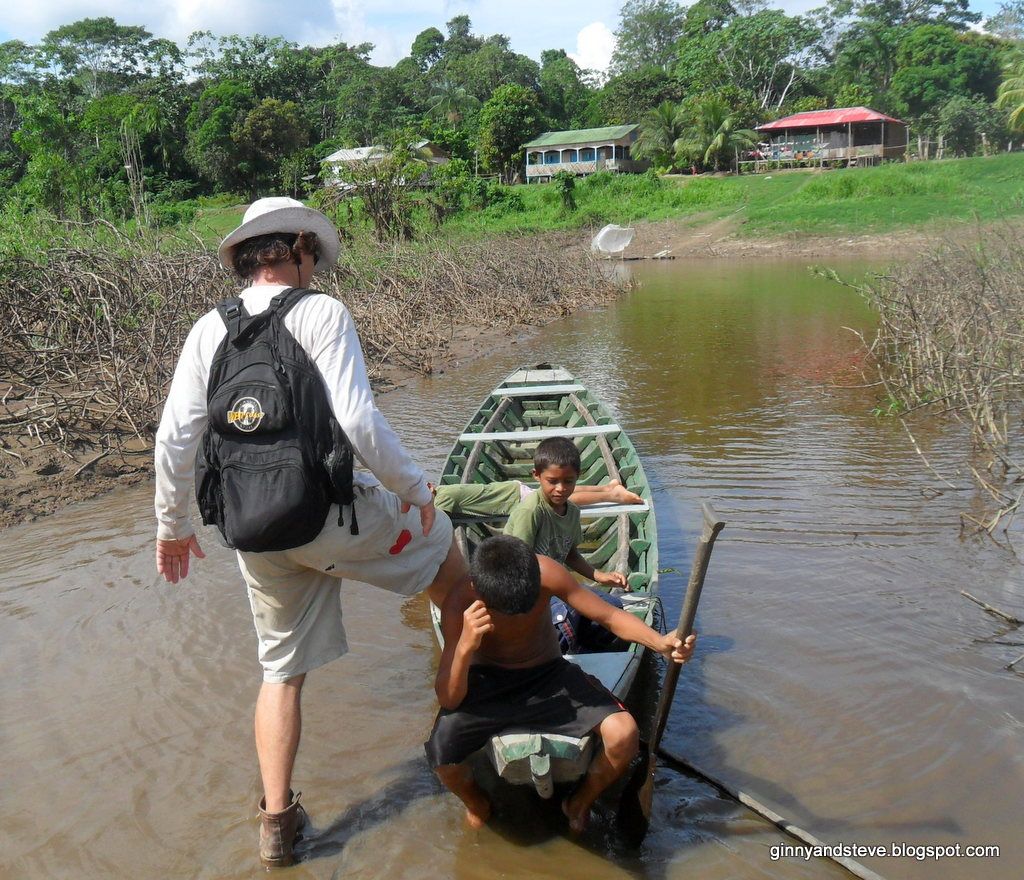
The church was a small door-less structure. The attendees were mostly mothers and children. They had a lot of Indigenous blood (but Cristian warned us not to call them indigenas because they consider this derogatory). Cristian donned his vestments. His theme was that changes were occurring in their world. “Some of these changes are good,” he said. “America has a black president now, did you know that? Other changes are bad. Beware the evils that will affront you and rely upon the guidance of the Church. Because the world changes but the church does not change!” He affirmed their worth as individuals, and advised them not to use condoms! (They evidently don’t, because most families had eight or nine children.)

That night over dinner Cristian pointed out an irony in that their work is to advocate, revolutionarily if necessary, for the poor riberinhos (river people), yet the Church oppresses its own workers. “The bishop has a car, air conditioning, everything, we have nothing!” said Ianda. “And women are kept in subservient roles. But this will change!”

But Cristian said the Church does not change,” Steve noted.

“Actually it does,” she said.

The Edigio Vigano’s chairs were all semi-broken, so when we got to Humaita we bought them six nesting chairs as our thank-you. Then the captain showed us a shop where for $775 we bought a motor rabeta and had a mount fabricated that attaches where the rudder normally goes.

Three days later, on July 3, 2012, we arrived in Porto Velho, a city of 400,000 and capital of the state of Rondonia. Huge barges were moored along the bank. One was being loaded with soy beans via a chute that emitted a plume of chaff. At the small-boat waterfront laborers were paving a new plaza. Brazil’s highway network extends to Porto Velho, so for once we felt connected to the rest of the country.

We tied up to a passenger terminal built on floating logs and started looking for transportation around the dams and rapids that block further navigation. A naval official said that above Porto Velho the river is navigable only in short isolated stretches. However, the local fishermen and our own satellite-image research said we could boat from Guajara-Mirim, 200 miles north on the Bolivian border, to a place called Vila Bela in the neighboring state of Mato Grosso.

We roamed the city looking for a boat trailer. The manager of a boating store connected us with someone who had a trailer and a Toyota Hilux pickup. We agreed to pay him 900 reales for the move, about $475.

A couple days later we met him at a boat ramp. The road to Guajara-Mirim was pot-holed, the land flat and studded with termite mounds. Guajara-Mirim was dusty and spread-out. The driver unloaded us at a ramp and left, but we kept Thurston on land another day in order to install a wooden skeg (a small keel at the stern). We needed one because without the rudder Thurston had wanted to swerve left or right. Then we launched Thurston in the Rio Marmore, a tributary of the Madeira.

Guajara-Mirim would be our last large town, so we filled up two extra fuel jugs. From the local capitania dos portos we got a clearance to Corumba, a city on the Paraguay River. That night, as we slept afloat at the landing, boats kept arriving quietly without lights, unloading gas drums or household goods, then departing. They were smuggling Bolivian goods, avoiding the high Brazilian duties. One load delivered consisted of nothing but wooden tables and chairs!

To get a map of Bolivia we crossed over to Guajara-Mirim’s Bolivian sister city. The officials there didn’t require us to legally enter Bolivia just to shop, the Bolivian side being a free trade zone. The first sign that we were in a new country was the traditional clothing of many of the women: long skirt, a colorful smock, braids connected in back, and a hat.

On the Rio Madeira we had ascended 1,056 river kilometers. On July 9 we left Guajara-Mirim to finish our upstream leg: 1,462 kilometers up the Marmore and Guapore rivers to the head of navigation at Vila Bela. On the Madeira we had travelled southwest, now we went southeast.

Operating the motor rabeta took getting used to. It was so loud we wore ear plugs and used sign language. The motor vibrated so much the bolts holding the tiller in place kept breaking. We drilled the holes larger and inserted larger bolts. The motor rabeta is also very sensitive to lateral weight distribution. The boat wants to turn in the direction of the lighter side. You have to balance the boat exactly or exert constant pressure on the tiller. Our extra-long tiller got us further away from the noise, but the tiller and “little tail” got in the way. One day as we were rounding a sharp turn with the throttle wide-open the whole motor jumped up out of its mount and landed in the cockpit with us! We kept it tied down after that. Though we got little exercise we were exhausted by the end of the day.

The boats above the rapids were fewer and entirely different. Instead of curvaceous “Popeye” boats we saw flat-bottomed, diesel-powered barges made from heavy timbers. Some were open, others had boxy houses of one or two stories.

At the junction of the Guapore and Marmore rivers we kept left on the former, which remains the international border. After a week we reached the town of Costa Marques. We refueled there and at Porto Rolim. The towns kept getting smaller, the river traffic less.

The river slowly changed. The Guapore meandered deeply, often doubling the distance compared to a straight line. Muddy banks gave way to sand. We were glad to see the mud go, but as the river got shallower sand bars became a problem. Often we were no longer able follow the insides of the bends. We constantly probed for depth with our boat-hook. Our GPS map (created with Google Earth at a cyber café in Porto Velho) told us which way to go at forks. Its speed read-out helped us decide how to position ourselves laterally in the river. A GPS shows absolute speed whereas speed relative to the water remains constant at a given throttle setting. Therefore a faster GPS speed means less current. We averaged eight kilometers per hour (four knots).

A cold front hit! We were still only twelve degrees below the equator and 550 feet above sea level, but July is mid-winter in the Southern Hemisphere. A frigid wind blew off the Bolivian Andes, 250 miles away to the southwest. We wore all our clothes and slept with the cabin hatch closed. There air smelled like autumn.

One night we slept tied to a dangling vine on a long, skinny island. When we cast off at 5:30 a.m. it was still dark but there was a rosy line on the east horizon. A thick mist was rising from the river. The motor wouldn’t start! It had gas and spark but wouldn’t fire.

We waved our flashlight at a passing canoe. Three Bolivian fishermen were returning home from a night on the river wth several large spotted catfish. They couldn’t solve the mystery either so they towed us upstream to a low-tech Bolivian naval base.

The comandante welcomed us and gave us a mechanic. This fellow tinkered for hours. The calls for breakfast and lunch came and went. The sun got hot as it rose high in a cloudless sky. At a bugle call a hundred joyous men came down to the river, stripped to their skivvies, and bathed all around Thurston. Ginny demurely kept her distance but she counted them, so she must have been looking. Steve and the mechanic worked with the motor on an old upside-down boat under a tree. It was challenging to switch back to Spanish after long immersion in Portuguese. Finally the mechanic found the problem: a sticky intake valve.

“But I don’t have any emery cloth,” he said.

“I’ve got some!” said Steve, and came back with a piece.

“The American has everything!” he said, impressed. He cleaned it up, put the motor back together, and got it running. We had lost only six hours!

The rabeta consists of a long shaft running through a tube. We discovered that the four evenly-spaced bushings holding the shaft in alignment inside the tube are made, in true third-world style, of wood. By July 21 these had become worn, so in the town of Pimenteiros d'Oeste we had a woodworker replace them. Meanwhile, at the local internet service we ran into a missionary from Mississippi, the first American we had met since Cartagena. Ernie C. had blond hair, blue eyes, and a thick Southern accent. “I had a misguided youth,” he said. “In fact I was even shot once. Oh, you might say it was a drug deal gone bad. But God had plans for me. I could only ignore Him for so long.” Working alone through an interpreter he must have been lonely because in the few hours we spent together he loaded us with details from his life and how he had ended up in a small town in western Brazil. “This here’s the end of the road,” he said. “You don’t come to Pimenteiros unless you mean to come here.”

It’s a shame to travel so quickly, and torture for Ginny to get up early, but the ticking clocks on our Brazilian visas roused us the next morning at our usual 5:45 a.m. There would be no more towns until Vila Bela, where the Guapore issues from the Mato Grosso pantanal (swamp) like a trickle from the world’s largest sponge. Mosquitoes like dawn almost as well as dusk, but in this case they made a weak showing, numbed by the mist and soon brushed aside by the eight-kilometer-per-hour wind of our progress through the stream. When the sun rose high, however, a heat-loving insect began his stalk. The black fly with clear wing-tips intercepted Thurston as she passed and awaited its moment to pierce our bare feet with his syringe. If we made the mistake of stepping onto a sandbar with bare legs a striped no-see-um like that on the Casiquiare (our magnifying glass justifies itself at times like this!) would hurt us until the distinctive sting of his bites dissipated.

Not much larger than a no-see-um, a tiny beetle of unknown eating habits and life-cycle had long since invaded the cabin. Moths lived in our noodles. Two varieties of weevil subsisted in our flour and rice. (Sifting removes them but our next food purchase would probably bring more.) Two or three species of ant generally walked around wondering what to do with themselves now that they are cut off from their colonies. (We don’t spray ant poison unless they come in strength.)

On the positive side, likable spiders and grasshoppers fell aboard when we scraped against branches. New species of butterflies, dragonflies, and wasps were always touching down. After the mosquito hour had passed the various mayflies, gnats, and crickets crowded aboard, attracted by our headlamps. Some passed through the mosquito nets and tickled us by crawling on our faces while we read. But our favorite nocturnal visitor was something we have no name for. Two inches long, it flies aboard then scurries without stop, every now and then executing a back flip. On one such flip Ginny swears he caught a mosquito in the air! His body is flexible. His abdomen is similar to that of a cricket but his thorax and head are more like a tiny lobster with powerful “forearms” of unknown purpose, unless it was to catch that mosquito.

The further we got upriver the more wildlife we saw: turtles, alligators, river otters, dolphins as always, capybaras by the dozen! The latter is a 150-pound rodent with a body the shape of a hog, a square head, and rich brown fur. They sat on low marshy banks feeding on the vegetation as we passed. We now saw green kingfishers in addition to the red-bellied ones. Cranes, storks, herons, egrets, mergansers, and cormorants abounded. On a given beach among several dozen such birds we sometimes saw a few roseate spoonbills, the color of pink flamingos but with spoon-shaped beaks. Several types of hawk or eagle were common. We’d love to have had a bird book, and a camera without a broken screen! Only the upper right-hand corner works so we have to frame shots seeing only that much.

At night we couldn’t identify animals by sight, yet this is when they were most active. We usually we slept in marshy bays that once had been river channels. All night we heard splashes, sighs, chortles, chirps, peeps, and grunts. We also need a device that identifies animals by their sounds!

Bedrock occasionally appeared through the green mantle. We passed to the left of a Bolivian mountain range and came within sight of a Brazilian one, the Chapada dos Parecis. Upon passing the mouth of the Rio Verde we left Bolivia behind. The Brazilian state of Mato Grosso now occupied both banks. Masses of filamentous vine cocooned the tall bushes among the swamp grass. The vines then died, leaving what looked like haystacks.

The river shrank to as narrow as fifty yards, then twenty yards. The scenery changed more rapidly. We no longer saw native dwellings in the sense of modest shacks, only a few ranches. For a while sport fishermen in small aluminum boats were common, then nothing. As we neared the head of navigation we wondered what could go wrong. We’d never met anyone who had been to Vila Bela. Steve got sick but soon figured out it was a cumulative effect from the water we had gotten from a roof tank in Guajara-Mirim. He filtered some river water using our pump-action filter, drank it, and immediately improved.

By July 25 the Guapore was a minor stream gushing through forest, swamp, and range land. The bends were so sharp we had to slam the tiller hard over causing Thurston to heel as she rounded up. Sometimes we miscalculated and crashed into the bank Then we saw a rabeta-powered canoe; somebody lives here! Rounding a final island we saw buildings: Vila Bela da Santissima Trinidade. We had completed our ascent!

Within two days we had arranged for a truck to carry us to the Rio Paraguay. Its bed was short so we unloaded Thurston to make her light. Then Steve, the driver, and five friends slid her bow up over the cab. The stern hung over the back of the truck but she was secure. For $370 the driver took us 300 kilometers across dry, flat land to the city of Caceres on the Rio Paraguay, where we are now.

This is the beginning of the Mato Grosso Pantanal, the world’s biggest wetland. We will descend the Paraguay as it snakes through it. Our next town, Corumba, is about 850 river kilometers away.

Bye for now,
Love Steve and Ginny

Monday, June 4, 2012

Manaus mass email #2


Dear friends and family,

We last wrote on April 21 as we were arriving in Manaus, on the north shore of the Rio Negro near its junction with the Amazon. Instead of drowned forests we now faced red bluffs. Mega-yachts sat under made-to-fit boathouses. Industrial and institutional buildings began sprouting from the heights. A new bridge stalked southward across the river on dozens of tall columns.

In Novo Airão we had met cruisers Peter and Louise. “When you get to Manaus, tie up with us, at Erin Shipyard,” Peter had said. We found it on a tract of sloping red clay just before the bridge. Petroleum barges were being built under big steel sheds. Ferry boats in red primer paint lay on ways. Welding torches sparked here and there. Floating workshops and drydocks lay moored along shore. One drydock held a huge barge. Workmen were painting it’s tall sides with long-handled rollers. A crane held the stern of a tugboat up in the air while men worked on its propellers.

We tied to the shoreward side of a barge and crossed a gangplank to shore. Red-bellied kingfishers chattered along an eroding bluff. We hiked up a steep drive us to a bus stop and caught the 124 to the Centro Antigo (Ancient Center).

The Centro Antigo occupied a bulge between two narrow inlets. Many of the buildings dated from the late 1800s and early 1900s, when Manaus was rich from the rubber boom. The facades of the old masonry buildings were molded in a heavy, neo-classical style. The grimy waterfront street butted against a sea wall. Tour boat operators hawked rides to the Encontra das Aguas, where the Amazon’s brown and Negro’s black waters meet. High-speed ferries streaked across the river. All along the waterfront floating gas stations lay about two hundred meters out. A passenger terminal accommodated a cruise ship and a score of triple-decker river boats. We particularly liked a class of wooden boats with forward steering stations, fantail sterns, and a roofed interior. They were styled after the big river boats but just big enough to fit a family.

Produce was being hand-trucked from rough-hewn cargo boats into a sprawling public market. One shed the size of an auditorium contained nothing but green plantains. Vendors sold exotic fruits, vegetables, and fish. The menus were full of unfamiliar dishes and juices. We treated ourselves to a liter of beer at the Bar dos Jangadeiros. If we understood him correctly, a fellow patron explained that the jangadeiros were Portuguese who came to Brazil on sailing rafts bringing their own musical style. A sextet was playing emotional folk ballads. The lyrics were so long that the singers had to sit together and read from a songbook.

We found a city map, got a customs exemption for Thurston, and exchanged money. In a neighborhood called Educandos we found the upholstery district, where we bought material for a new awning, which we promptly had fabricated. Rises and ravines divided the city. Forty years before it had only 200,000 people. Then the government created a vast Duty Free Industrial Zone where multi-national corporations have erected assembly plants, including the world’s biggest motorcycle factory. The population grew ten-fold.

There were roomy middle-class neighborhoods, but our missions generally took us into crowded sectors where the streets were narrow and winding. Through each ravine ran a open sewer. Even here the two-story shacks pressed close, on stilts to avoid flooding. The poorest areas were accessible only by narrow walkways. Everything was made of the same red brick, an extruded block with eight square holes. They often left the bricks unfinished, to be stucco-ed and painted when circumstances allowed.

Our immediate neighborhood was Compensa, a warren of steep streets and dead-ends. Our internet shop lay at the bottom of an urbanized ravine. The street crossed the valley transversely, thus it rose in both directions. One day, while we were working on computers by the plate-glass window, we witnessed a different sort of encontra das aguas. A cloudburst hit: gusts, lightning, torrential rain. Pedestrians took shelter. Water pooled in the street. The shop keeper took a specially-cut board outside and wedged it along the foot of the building to keep water out. Soon runoff was coming from both directions, colliding in front of the shop, and spilling out into a concrete-lined ditch running away from the shop, perpendicular to the street. The waters from the two slopes were a foot deep, lightning-fast, laden with garbage. They collided in a wave that swirled down into the ditch like into the drain of a sink. It became too deep for cars but buses still drove through. After an hour the rain tapered off, the water subsided, and the shop keeper removed the board.

This metropolis of two million sits alone in the center of the Amazon Basin. Manaus is like an island in a sea of rivers and forested floodplains. The Amazon is bigger than the world’s second through eighth largest rivers combined. Several of its tributaries, considered independently, would rank among the world’s top ten by volume. Due to these water obstacles no roads connect Manaus with Brazil’s far-larger cities a thousand miles or more to the southeast.

We were no longer in a splintered remnant of the Spanish Empire, under the shadow of the U.S economy. Economists class Brazil with Russia, India, and China: nations large enough to create their own momentum. The Brazilians seemed self-confident. No one hustled us. They were friendly and good natured nearly without exception. We surmise this is due to their fine appreciation of sweets and chocolate in particular. Brazilians have even found a way to spread their friendliness silently by their ubiquitous habit of giving a “thumbs-up” for any variety of reasons. For example, to say “Hi,” “Bye,” “Thanks,” “Okay,” or “Cool!” It’s a great boost to one’s self esteem to have people giving you thumbs-up all day. Hope we haven’t misinterpreted the meaning!

Brazil is South America’s only Portuguese-speaking country. The Spanish-speaking countries from Cuba to Venezuela had been variations on a theme, but Brazil was abruptly different. The various musical styles reminded us of Cajun, or sixties pop, or European folk songs, but they never reminded us of mariachi.

Brazilian Portuguese is similar to Spanish but with a soft, mushy sound,. Many consonants are pronounced differently. “R” sounds often become “h.” “H” sounds become “zh” as in “measure.” “B” sounds become “v.” “Ch” and “x” sounds become “sh.” “T” sounds might become “ch.” “D” sounds frequently become “j” as in “just.” We studied the language on our laptop with a program called Rosetta Stone.

The workshop barge we tied to sheltered us from the afternoon sun and from waves kicked up by passing rainstorms. The water was the color of black tea, opaque at depths beyond a meter. The air on the equator is warmer than one would wish but the river is perfect. In full sun the barge was too hot to tread in bare feet, but a leap into the water brought instant relief. We jumped in every night after tramping all over town in the overbearing heat. Soon we were jumping in every morning as well. Currently we are working in a lot of afternoon swims and before long expect to spend all of our time in the river.

At first it felt strange to live in an industrial shipyard. On all sides workers in bright orange coveralls clanged and clambered over vessels. Equipment and balks of timber lay everywhere. It seemed impossible that they would want us around. Wouldn’t our presence violate safety rules?

Peter assured us we were welcome. He was sixty-five years old, tall and hearty. Born in England, he had emigrated to Trinidad. Louise, his lovely South African partner, had more sailing experience, having sailed her own boat from South Africa to Trinidad before meeting him. They had sailed his fifty-foot motor-sailer around the Caribbean then up the Amazon. The Passagemaker, built from teak in Singapore in 1961, was famous as a prototype for yacht designer Robert Beebe’s ideas on trans-oceanic cruising under power. Peter and Louise often invited us over for drinks, conversation, and movie-swapping.

One day Peter and Louise took us on a cruise to an old rubber plantation up the river. The other guests were Francisco, the manager of the shipyard; Berlane, his wife and daughter of the shipyard’s owner; a Japanese-Brazilian plastics factory owner and his family; and other successful friends of Francisco and Berlane.

When Peter and Louise continued their cruise up the Amazon, Francisco and Berlane became our closest acquaintances. Francisco, a brown-haired, grey-eyed, native of São Paulo, spoke English with what seemed a French accent. Berlane was Amazonian by birth, blonde, always happy. They took us out to fine restaurants, a zoo, and tours of the city. The few parts of the city we hadn’t yet explored by foot, bus or bicycle Francisco made a point to show us by car.

Their welcome was a boon because a package coming from the United States was delayed. We kept busy with writing, laundry, boat repairs, and seeking hard-to-find items. (For example, we needed acetone in a quantity small enough to would fit in our repairs bin. The solution: fingernail polish remover.) Finding places was difficult because we could not find business directories or bus schedules. Businesses often did not post their hours of operation, so you didn’t know when to come back. Restaurants had no menus, vendors often didn’t bother with price labels. The lack of written information forced us to combat our shyness and speak Portuguese. 

We mapped upcoming rivers on Google Earth. Virgilio, our travel guide friend in Puerto Ayacucho had said it is possible to ascend a southern tributary of the Amazon and portage to the Paraguay/Parana River basin, so we researched it. We found that Virgilio’s projected route is now impossible because the Pilcomayo River, where it used to form the boundary between Paraguay and Argentina, has disappeared due to irrigation diversions. However, we concluded that we could go up the Madeira, Mamore, and Guapore rivers; then portage; then down the Jauru, Paraguay, and Parana rivers to Uruguay. We could even make a loop of it by then ascending the Parana to the vicinity of Brasilia, portaging to the Araguaia River, and descending it and the Tocatins to the Amazon near Belem! It would add a year to our trip.

In northern Latin America the rainy season is from June to November. In the southern hemisphere it occupies the opposite months. By crossing into Brazil we had gone from the waning months of Llanos dry season to the waning months of Amazonian rains. In Manaus the Negro/Amazon reaches its highest mark in June, when precipitation fallen on the Andes reaches that point. The river continued to rise as we waited for our package. By late May it had exceeded previous records. Low areas of the city were inundated. In the Centro Antigo businesses stacked sandbags around their entrances and erected elevated walkways along the flooded streets.

One day, while crossing the bridge from the Centro Antigo to Educandos, we noticed that the riverfront shacks, docks, and floating businesses continued under the bridge itself. Descending to river level, we saw that wooden and brick shacks had been built around the abutments, protected from rain and sun by the bridge high overhead. Crude plank walkways snaked from shack to shack. Some had a foot of water inside yet remained occupied. In some structures the downstairs was a combination bar/restaurant/store, with seating for two or three customers and shelves offering cooking oil, candles, etc. Laundry lines ran from upstairs windows to convenient attachment points. We sat at one of the “bars” and split a tall bottle of cold Brahma beer. Men drank quietly. Women cooked. Children darted in and out. Dogs, cats, chickens, and ducks inhabited whatever ledges they could find. The planks were wide enough for one person or animal at a time. People had top priority, followed by dogs, cats, ducks, and chickens. A dog accidentally nudged a fighting cock into the water. Someone reached over, lifted it by the shoulders of its wings, and set it back down on a plank, probably for the tenth time that day.

Another day, in the Lirio do Vale neighborhood, we noticed a walled garden with the words União do Vegetal over the gate. “Union of the Vegetable?” said Steve. “What the heck is that?” Peeking in, we were noticed by a handsome young man. He beckoned us inside. “We are a Christian group,” he explained. “In our sessions we take a special tea made of Amazonian plants. If you would like to try it come back on Tuesday at eight o’clock.”

Ginny was tired that night, but curiosity had the better of Steve and he wandered off into the night to check it out. The grounds were now inhabited by about forty men wearing green smocks and white trousers, and a smaller number of women. They were gathering on a covered patio around a table on which stood a white ceramic urn. One by one we drank a glass of tea called ayahuasca, extracted from the leaves of a tree and the sap from a vine. It was bitter and pungent. All sat on comfortable chairs. Five leaders sat on one side of the urn, the others sat facing them. Steve and other newcomers were placed to the right of the leaders. A chairman opened the session. He and others gave short talks. Members stood, were recognized, and asked questions. Sometimes someone would chant. There were long periods of meditation during which soothing music was played on a CD player.

At nine o’clock we were offered a second cup. Having felt no effect, Steve accepted. Soon his body felt wiry. Closing his eyes he saw colorful, slowly evolving patterns suggestive of plant growth or zeppelins or skyscrapers, composed of light arrays like a pixilated TV screen. He noticed certain words being repeated, like espiritu, vegetal, Gabriel, and Soloman. He fell into a dream state that he could at any time terminate by opening his eyes.

At eleven-thirty the ceremony ended. People lingered, chatting in good humor. Some ate. Steve maintained his intoxication until a man sat by him that emitted a sharp odor. Suddenly Steve had to vomit. Fortunately a restroom was nearby. Instant sobriety! He was then given a ride back to the shipyard. He woke the next day feeling refreshed.

After weeks of waiting for our package we have finally have it! We have gotten a fresh 90 days on our visa and are ready to continue down the Amazon. Should we go straight to the Atlantic and sail back to the States, which would take at least a year, or go up the Madeira and explore the rest of South America first?


Bye for now,
Love Steve and Ginny
Lots of new photos can be found here: https://picasaweb.google.com/ginnygoon/Brasil

Saturday, April 21, 2012

Manaus, Brazil - Mass email


Dear friends and family,

We last wrote you from São Gabriel da Cachoeira, a city of perhaps 50,000 people in Brazil’s remote northwestern corner, where it adjoins Colombia and Venezuela. The dry llanos of those countries had fully given way to equatorial tropics, though the land remained predominantly level and low.

We managed to exchange our leftover Venezuelan and Colombian money for Brazilian reais (pronounced hay-ishe). We had no navigational map of the Rio Negro so again we found an internet shop and created our own using Google Earth. The distance to Manaus was about a thousand river kilometers. Though we represented shorelines by only about one click per kilometer, and rapidly traced our route via the satellite images, the task took twenty-five hours. Most of the way the river contained at least one long, sharp-ended island, sometimes as many as ten abreast! In some regions vegetation and water intermingled in vast swamps, visually fascinating but hard to map. In a few arbitrary clicks we categorized untold watery wonderlands. 

The river’s undulating shapes as viewed from above reflected its slow writhing over time. In places vast striations reflected the river’s accretions, its migrations toward the outside of each bend. The striations mimicked the river’s curves, each line representing a former shoreline or silted-in channel. There were also breaks in the pattern where the river had cut new short-cuts. We saw “hollow” islands with lakes almost their own size, channels that tapered to nothing as they stabbed into land masses, and dozens of converging tributaries, some so large as to merit their own delta archipelagos.

The imagery couldn’t tell us where heights of land might exist, nor which areas of dense tree canopy would be dry and which would be inundated. The presence or absence of whiteness, however, told us that the only significant rapids were those near São Gabriel. A riverboat owner named João took Steve for a motorcycle ride along the river road, pointing out the best route through the first and worst drop.


It was March 12, 2012. The river was at moderate height and rising. Ginny, though scared, chose to accompany Steve through the rapid, in case the inevitable capsize should leave him in need of superhuman assistance. Just downstream of our tie-up the river compressed from a mile in width to a mere quarter mile. The shoreline there was whitewater but the middle was black and roiling. Casting off, we motored at an upstream diagonal to the river’s centerline, just missing the first set of rocks. As we entered the apparently placid narrows, patches of river suddenly boiled up and whirlpooled around us! Current speed far exceeded our through-the-water speed, so we noted the horizontal alignments of near and far objects to sense how fast we were going and in which direction. When we were clear of the first hazard we angled back to shore to avoid the cachoeira itself, where the river drops over a ledge of perhaps eight feet. By staying close to the granite bank we sped down a swath of unbroken water which soon deposited us, swirling and bobbing, in a quiet embayment.

For twenty kilometers the river remained broken into islands, rocks, and riffles. Then the river compressed once more, mightily. Here we had no choice but to bump through a series of white corduroy waves. To Steve it was fun, to Ginny it was anything but.

Thereafter the current was mild. The hills and round granite rocks we had been seeing since Caicara slowly subsided until only flatland remained. In spots we could see an actual bank. More commonly the competition for sunlight in the foliage was so intense that branches and vines extended well out over the river. It did so in varying degrees, forming “vegetative coves.” We kept our distance just enough to prevent Thurston’s projecting parts from catching on something. The forest edge was a verdant wall with varied adornments. There were vertical stalks with tiny white flowers in a “zipper” pattern, vines with leaves like elephant ears, maroon trilobytish lichen, small red and green bulbs like Christmas lights hanging off the brush, and a thousand other mysterious plant forms which we gazed at as we floated past.

 You may remember how we hurried along the coast of Panama, Colombia and Venezuela to avoid the stronger winds that begin in December. Inland Venezuela was also rushed as we desired so strongly to escape the clutches of their Big-Brother government. For once we were in no hurry! The water was fresh and clean, facilitating bathing and washing. There were almost no waves. The wilderness was pristine. There were no more biting insects, due, we were told, to the tannic acid that makes the river look black. So we decided to slow down. 

Our first indulgence was to ascend a randomly-selected tributary on the north bank called the Rio Cauaburi. About the size of the Washington’s Skagit River, its watershed is within the Parque Nacional do Pico da Neblina, named for Brazil’s highest point, on the Venezuelan border. We motored along as close to the bank as possible to minimize current, weaving in and out to avoid branches. We connected the steering lines, left the awning up to shelter us from the intermittent sun and rain, and had great fun navigating our miniature ship from the companionway hatch.

After a couple hours we arrived at a rapid which we were unable to climb. Upstream the river braided around rocks and thundered toward us, but in a bay at the outside of a bend we found a forested slough leading into the jungle. By lifting a few branches we squeezed inside.

 
Here under the forest canopy there was no wall of leaves separating us from land. We parked between two trees and explored, minding our track with a compass, observant for any dangers. There were small palm trees covered with long spines which we had to avoid grabbing whenever vines tangled our feet. Ants crawled up and bit us if we lingered in the wrong place, and unidentified animals had burrowed holes which needed avoiding. Where big trees had fallen they had pulled the vines down with them and the hole in the canopy had allowed dense shrubs to proliferate. Elsewhere the forest was walkable. Only the newness made us careful. Overhead a copper-colored monkey returned our stare. We found a five-inch-long grasshopper that wasn’t afraid of us, a cinnamon-colored tarantula on a rotten stump, and a small mantis-like stick bug. Then a cloudburst hit, and the leafy forest floor, though well-drained, soon puddled from the intensity of the rain.

No people detected our presence, but a river otter examined us while chomping a fish nearby, his big, round head above water. We felt isolated yet safe. We were at peace and had everything we needed. But, since that is an unnatural (and therefore unstable) state for humans we left our satori after two days and continued on our way to “civilization.”

The wilderness and the monotony of our travel resulted in much philosophizing and introspection. We ruminated on the meaning of life, human purpose, and the existence of God. We wrestled with the concept of remoteness. Since Puerto Ayacucho the towns had been far apart with no connecting roads. Nor had we noticed any long-distance trails. Native villages exist here and there on the rivers and streams, but what about the vast forests beyond that? Is much of Amazonia simply uninhabited? Steve found this idea subtly disturbing, while Ginny relished it. We struggled with the desire to keep exploring deeper into the wilderness and the logical impracticality of it. In wilderness travel is there always someplace even more remote you can’t reach?

With the right gear could one hike into lands of which even the natives know nothing? Could one ever find a nirvana in which sloths could be cuddled, being too slow to run away, and spotted agoutis minutely observed? When if not now would we ever penetrate nature’s next layer of secrecy? The rivers injected renewed enthusiasm into our voyage. We daydreamed of following them into Colombia, Peru, Bolivia, Argentina. We even fantasized about trading Thurston for a riverboat, becoming beekeepers, having a kid, adopting a cat and turning our voyage into a permanent lifestyle.

Then what of our families, friends, professions, possessions? Might we not eventually become lost to our former senses of belonging? Our subconsciouses suggest this is already occurring, to Ginny and Steve in different ways. We have already been traveling for over two years. When will the wanderlust wane? Setting these dreams aside for future voyages we agreed to continue toward the mouth of the Amazon then turn left, back toward the States.

With this sobering decision in mind we continued down the Rio Negro. Typically we rowed for two or three hours per day and motored for five or six due to mild headwinds. With the awning always up clothing was optional. Sometimes the river was so wide that large extents of the horizon were land-less, like we were looking out to sea. Other times we were in a maze of islands. Sometimes the only dry land was a narrow strip along the river, its natural levee. Then even those went away and we could no longer go for walks. Fortunately, rowing with a sliding seat exercises the legs as well as the upper body. Pink dolphins were common, but never so active or interested in us as were those on the Portuguese and Apure rivers. The narrower channels abounded in lime-green parrots and macaws of both the scarlet and blue species. All flew in pairs or larger groups and were very vocal during the day. At night monkeys howled, cicadas whirred, frogs “croaked” in strange new ways, and bird calls of every description reverberated through the forest. Once we even heard the guttural growls of a wild cat accompanied by lots of splashing. Closing her eyes Ginny could have sworn it was her dear cat Snazz munching on a hotdog. 

It being the rainy season, the river was seven or eight meters higher than in the dry season. This allowed us to camp under full canopy in drowned forests. We also stayed along quiet banks and in open water with scattered trees and brush. One night we anchored in a swampy cove of a bay in a lake inside an island! On another we settled into a side-channel not knowing if an island or a peninsula separated us from the river proper. As it turned out it was neither, because in the morning a boat passed by, which we heard but could not see. Its wake came right through the forest and rocked us.

It was springtime for the trees. Fist-sized “acorns” often splashed from the canopy into the water. The locals were gathering wild Brazil nuts, whose container case resembles a cannon ball. There were big crimson bean pods; and grey-green discs which, when opened like a clam, revealed a horizontal stack of thin, seed-bearing wafers.

At first we supposed that a tree standing in water wouldn’t have ants. Wrong! Our worst invasions came from contact with vegetation on which there were thousands of desperate small ants. Perhaps they get “treed” as the river rises then die off unless they find another home. We have also heard they make bridges with their own bodies to move among the inundated plants. We spent hours washing them off with bucketfuls of water and smashing them as they scurried about. We executed mercilessly, though in Ginny’s case it was not without remorse. After that we reached down and tied our mooring lines below the waterline of branches or trunks so nothing could climb aboard. We tolerated spiders and crickets. We would have exterminated the tiny flies and beetles that appeared in the cabin if we knew how to. Most mornings we had to get an early start because honey bees swarmed us at about 7 AM, but they soon flew away when we left. 

 
Sometimes we passed a paddled dugout, a planked canoe with a “stick-out motor,” or a barge. We saw fish traps along the bank looking rather like half-submerged outhouses made from slender poles fastened close together on a flimsy frame. Here and there trees had been cut, milled with chain saws, and the rough lumber removed. The wood was red and heavy. We dropped a scrap in the river and it sank.

We took a side trip up the Rio Branco for a couple days, stopping at a small community to trade an empty gas bottle for 10 lbs of fresh brazil nuts! Otherwise we rarely stopped at indigenous communities because they often had “entry prohibited” signs. We assume they just do not like visitors, though we have read there are still communities remote enough to be threatened with extinction by the common cold.
There were only four towns big enough for provisioning and we spent time in each. Barcelos was our favorite and the one in which we spent the most time. It was peaceful and clean, active and friendly. The military guys we passed as we pulled up to town merely gave us a smile and a thumbs-up. The first and only drunk who approached to beg for money was quickly halted and criticized by his friends. “Don’t bother them, they are tourists!” We marveled at the contrast of this Brazilian experience to our Venezuelan, feeling like we were still healing from the escape of an abusive relationship! 

The other three towns were unique and equally charming. They were Santa Isabela, Moura, and Novo Airão. Other "big" towns showed on the map, but if they had ever existed they were overgrown now. The towns generally had few restaurants or stores, but we had no trouble stocking up on the essentials. In towns we moored alongside other live-aboard families, many of whom had traveled long distances to provision or sell their crops. Some lived in boats with thatched roofs and removable side tarps; others in miniature river boats with forward pilot houses, diesel engines, and fantail sterns. They were poor but happy with infinite kids, a dog or cat and plenty of hammocks. Our pathetic Portuguese hindered communication, but they were friendly and accepting. We had finally found a boating community to which we could relate. 

The world’s biggest fluvial archipelago, the Anavilhanas, began near Novo Airão. They were a profusion of inundated islands, up to fifty kilometers long, like emerald ribbons streaming in a current. Some were bulbous with interior lakes to which we could find no access. The water’s commonest mood was steel gray and oily smooth. When we exited these islands the river was several kilometers wide and thirty to fifty feet deep with very little current. A diagonal crossing from one side to the other took two hours, during which the daily rainstorm packed with lightning and black clouds passed over, blinding us and kicking up waves.

After days of nothing but riverine swamp we began passing tall red river banks. Then on March 6 we saw skyscrapers in the distance. The river corridor had remained relatively untouched until its very end, where Manaus sits on the north bank. The transition from wilderness to a metropolis of two million people was abrupt and kind of painful.

In Novo Airão we had met a charming couple traveling from Trinidad. They had come up the Amazon in their famous motor-sailer, the Passagemaker. We were the first sailboat they had seen coming up the river and they were the first we saw coming down it. A friend of theirs owned a big shipyard in Manaus and on his behalf they had invited us to tie up there. We approached the city with this in mind, exploring the little inlets along the way as is our custom. We were overwhelmed by everything. There were motor yachts, jet skis, skyscrapers, barges; everywhere activity on a large scale. We tied up beside Passagemaker on a huge floating dock where barges were under repair. A new bridge loomed nearby, separating us from the downtown. 

We expect to be in Manaus another couple of weeks. Having already tried your patience with this novel (in which we could only scratch the surface of our experience), we will reserve an in-depth description of Manaus until our next email. Enjoy the many new photos to be found in: http://www.picasaweb.com/ginnygoon/brasil

Friday, March 9, 2012

Sao Gabriel da Cachoiera, Brazil


 Dear friends and family,

We last wrote you from Puerto Ayacucho, where we obtained the permits necessary to continue up the Orinoco River into Brazil. The grand finale was a boat search by the Department of Military Intelligence that took seven men three hours. They even checked our camera and computer storage devices, but still couldn’t find any incriminating material. During the process a couple of them sidled up to Steve and whispered that they want to go to America. Like this was the Cold War and they wanted to defect to the West!


On February 17, 2012 Virgilio, our hard-working friend and tourist agent, loaded Thurston onto a trailer and towed us with his old Toyota pickup over a paved road to Samariapo, a landing upstream of the rapids. About a hundred boats were there, mostly bongos (long, slender, steel canoes with outboard motors), transporting people and supplies on the upper river.


As we continued upstream Venezuela was still on our left, Colombia on our right. If the current was too strong in one channel we found another. There were now hills on both sides of the river and the forest was denser. At the town of San Fernando de Atabapo the river turned away from the border; both banks were now Venezuelan soil. It was a relief to get away from that source of tension. The armed forces of the two countries are hostile toward each other, and Colombian guerrilleros still operate along the border on a reduced scale.

After Atabapo we followed the river southeast. It shrunk as we passed tributary mouths but it never became less than a quarter mile wide. Running our motor at 2/3 throttle we circled around sandbars and globular granite rocks. Sometimes we hugged the bank, other times we went down the center. At times we walked the boat when it became too shallow, the river being very low at this time of year. Our 100 liters of fuel resided in 20-liter containers lashed to either side of the cabin. We gave away the containers as they became empty. We used up the last of our bread and fruit and dug into our canned food. We passed a couple indigenous communities per day, typically ten or so neat mud-and-wattle houses and an open assembly hall around a grassy common. The foreign missionaries who organized these evangelist communities were expelled about ten years ago, though Venezuelan missionaries still visit. In some villages they spoke Wotuja, in others they spoke Kurripako. The people mostly ate fish, yucca, and plantains. They were friendly and quiet.

In Venezuela gasoline is virtually free. To keep the Venezuelans from reselling their gas to Colombians across the river the government requires all boats to stop at a string of Guardia Nacional checkpoints and get their papers stamped. We stopped at six such posts. Some coincided with indigenous communities, some were just a building in the wilderness. The young soldiers were bored and listless.

All day we droned upriver with our earplugs in, probing with our boat hook to check water depth. We now passed among tepuys: huge mesas such as Sir Arthur Conan Doyle popularized in his book The Lost World. Scarlet macaws flew overhead in twos and threes cawing like crows. Large black-and-yellow birds tended their young in teardrop-shaped nests that hung from the trees. Rust-breasted kingfishers flew from one overlooking branch to another. Then Jackpot! Ginny spotted an animal swimming across the river. Steve motored to it. A giant ant-eater! It reached the far bank and pulled itself out of the water. We gasped as it revealed its great length, six feet counting its big bushy tail and long, droopy snout! It tried to climb the bank but it was too steep, so it followed the waterline until it disappeared in some vegetation. Someone told us each anteater paw consists of a single gigantic claw! Another time we surprised a swimming cougar! When it saw us it turned around and swam with surprising speed to the shore it had started from, where it stared at us until we were past.

On our seventh day out of Puerto Ayacucho we reached the geographic phenomenon we had long yearned for: the Brazo Casiquiare distributary! There was no signpost, no break in the uninterrupted jungle. Maybe one twentieth of the Orinoco simply split off and disappeared southward toward the Amazon. Both branches would eventually reach the Atlantic but via mouths that are thousands of miles apart! We had reached the hump. Until now any mechanical malfunction could require us to give up and follow the Orinoco back downstream. Now we could row with the current. Until our gas should run out we fell into a new pattern of rowing three hours per day and motoring for six.

Local tributaries quickly added their translucent black water to the turbid brown Orinoco water that the Casiquiare had started with. Initially only fifty yards wide, it grew and became blacker and clearer. This was the most isolated part of our passage. The communities which our maps showed along the Brazo Casiquiare didn’t exist. For four days, averaging seventy kilometers per day, we saw no sign of man on shore and few boats on the water. When not steering the boat or admiring the scenery Steve practiced the guitar or sewed, Ginny read or washed clothes.


On the Orinoco we had slept moored in front of native settlements or well-hidden in tributary creeks, for security and privacy. Here there was no need to hide. We camped at scenic confluences or next to dramatic rocks. In the twilight bats fluttered about like large moths. It was frustrating to hear strange night calls and have no idea what was making them: birds, bats, insects, monkeys? One morning a coral snake slowly swam along the swampy shore we were tied to. “Red next to yellow you’re a dead fellow, red next to black you’re alright Jack,” recited Ginny. “He’s got red next to yellow so he’s poisonous!” By day a new species of biting insect plagued us, between a mosquito and a no-see-um in size, whose itchy bites have a red dot in the center. We battled one ant invasion after another and learned to tie up to trees that stand in the water so they can’t come aboard.

On the fourth day we arrived at a Yanomami settlement. These people are usually photographed wearing loincloths and with narrow sticks inserted horizontally through the skin of their faces. Our Yanomamis, like the other indigenous people we had met, wore factory-made shorts and skirts. We landed where a crowd of children were playing in the river. Ginny swam with them while a tiny man showed Steve around the thatch houses. On the packed earth under an open shelter a young man was hypnotically chanting and dancing. He wore paint on his face and arms and had feather arrays projecting from either side of his head. Steve’s Spanish-speaking guide said he was under the influence of a drug, a powder that one person blows into the nostrils of another. He said that the song was traditional and is for communicating with nature spirits.

Tribal villages proliferated as we neared the mouth of the Brazo Casiquiare. On February 29 the latter joined the Rio Negro. Each was a half kilometer wide, of the same translucent black. We now had Colombia on the right bank again. On the left bank was San Carlos del Rio Negro, administrative center for this remote part of Venezuela.

San Carlos didn’t have internet or a restaurant, but it had a Guardia Nacional post and a naval base. The naval comandante, a fastidious man with a golden retriever puppy, invited us into his office. He fondly reminisced about living in Alabama as a teenager while his father attended F-16 flight school. He showed us his cherished photos of Epcot Center and Disney World, but he also defended Chavez’s policies. We responded just enough to be polite. He complained that the U.S. won’t sell them spare parts for their Hercules air transporters, and that CNN distorts the news about Venezuela. He went on for hours in a curious balance of friendliness and tension. He seemed torn between Chavez’s xenophobic demagoguery and a repressed fear that Venezuela was becoming increasingly isolated. “We need a change!” he murmured. He also had nothing good to say about the Colombian navy, who had a base just across the river from his own. “They buzz by here and goose their engines just to provoke us!” he scowled.

On March 2, when our GPS indicated that we had left Venezuela, Ginny high-fived Steve. “Adios assholes!” she bellowed, referring not to the generous people but to the government. Their policies had complicated our lives in ways we have explained and in another matter which we can divulge now that we are out of the country. It pertains to their currency.

The bolivar is a controlled currency, meaning that the government sets its official value relative to other currencies. The value it sets is artificially high, so if a traveler exchanges his or her native currency for bolivares in a Venezuelan bank or ATM (which automatically converts the withdrawal to bolivares) his or her cost of living while in Venezuela will be about twice as high as the free market would dictate. We had gotten around this by:
1) estimating how many months we would be the country,
2) multiplying that by our past average of expenses per month,
3) building up a stash of US bills in that amount while in Colombia (we had to convert to pesos then back to dollars), and
4) exchanging our dollars for bolivares on the black market in Venezuela.

Carrying thousands of dollars in cash had added to our stress. So had the black market transactions. In some towns it was easy: you just ask around at stores. In other towns it was difficult to find a dealer. Then we ran out of dollars due to the fees levied upon us and the long waits for permits. We got around this once by a quick visit to a Colombian ATM and another time by using PayPal to transfer funds to the U.S. bank account of an affluent Venezuelan. Once the transfer cleared he gave us our bolivares at the good rate. We’d had to hide all this activity from scrutinizing officials as it is a crime punishable by huge fines and possible imprisonment.


All that behind us now, we hungrily opened our senses to this new country. Brazil was huge and flat, still totally forested but with isolated mountains here and there. We had entered a region still in its rainy season; showers were frequent, otherwise it was very hot. The banks were often inundated forests. There were palms with upward-radiating fronds and hardwoods with buttress roots. Some trees sported yellow or magenta flowers, others had large pendant pods. Giants with thick, straight trunks held spherical canopies above all the others. Vines smothered many trees. Curlicue rope vines dangled here and there, their tips often dragging in the river current. The people, mostly indigenous, drove dugout canoes sporting outboard motors with long propeller shafts projecting aft into the water. One had a radio playing. To Steve’s unaccustomed ear the music sounded like Cajun: rock-and-roll chord progressions at dance tempo with accordion and strings. The settlements had plank-built homes, old stucco churches, and stands of coconut and banana trees.

One campsite deserves special description. As the sun dropped low we descended a side-channel of the river, mainland to right, island to left, until it squeezed through a rocky defile. On the mainland side of the gap, obscured from the river by a heavily-forested hemispheric peninsula of igneous rock, was a small, semi-circular cove, the walls of which were of the same smooth rock. We tied to roots and pulled ourselves up. It was the same geology we had been seeing since Caicara, but here the immense rainfall caused trees to root in the bedrock and a deep leaf litter to form. The forest floor was like a soft, springy mattress! A gentle chaos of stray eddies wafted Thurston left then right. A pink dolphin hunted among the stronger currents at the cove’s neck as the setting sun turned the clouds pink and blue.

On March 5 we passed through a vast archipelago of forested islands interspersed with rapids where the river dropped over shelves. While Steve concentrated on the chutes Ginny watched the GPS while its latitude readout run down to º0.000.000: the equator! Just beyond, on the left bank, lay Sảo Gabriel da Cachoeira. Cachoeira means waterfall, the city being located just above where the mile-wide Rio Negro falls thunderously over a shelf. The shoreline was crowded with wooden boats, many of them roofed and inhabited by large families. Boats with fish and yucca were arriving while others loaded to the gunwales with cooking oil and bags of rice were heading upriver.

We landed next to a barge on which cane liquor was being served to drunken Indians. They held their hands out to be shaken. To shake with them was like squeezing a sponge: passive, soft, and wet! There were cars in the streets and government offices where we were politely escorted through the Brazilian entry procedures. Portuguese is similar to Spanish except for the pronunciation so we are getting used to its soft, lisping sounds via the Rosetta Stone course which we have on one of our laptops.

They have internet here. We will catch up on our writing and Google Earth mapping then begin the 1000 river kilometers to Manaus. We’re not sure what we’re doing after that but we are thoroughly enjoying this new phase of our journey.

Bye for now,
Love Steve and Ginny

New photos can be found in the Venezuela album here: https://picasaweb.google.com/ginnygoon/Venezuela
And Brasil album here: https://picasaweb.google.com/ginnygoon/Brasil